
More people than ever are challenging NDIS decisions, and the wait for an answer is getting longer. In 2025–26, the Administrative Review Tribunal (ART) received 9,351 applications to review NDIS decisions. That’s about 130% more than two years earlier, and the typical appeal now takes 34 weeks to finish.
If you or someone you support disagrees with an NDIS decision, this guide explains how an NDIS internal review works, how to appeal an NDIS decision to the Tribunal, what the new figures mean, and the practical steps that protect you while you wait. It’s plain and practical, and every figure links to where it came from.
In short
- NDIS appeals to the Tribunal rose 18% in one year and roughly 130% over two years.
- The median wait to finalise an appeal grew from 27 to 34 weeks, and 7,077 cases were still open at 30 June 2026.
- You must ask the NDIA for an internal review within 3 months first, then apply to the Tribunal within 28 days of that result.
- Any cut to your funding applies straight away, even while you appeal.
- Free NDIS advocates can help you through it in every state and territory.
How to appeal an NDIS decision: the 2-step process
Challenging an NDIS decision has two steps, and you can’t skip the first: an internal review by the NDIA, then an external review by the Administrative Review Tribunal. Think of the Tribunal queue as a waiting room that fills faster than it empties. The earlier you start and the better prepared you are, the better.
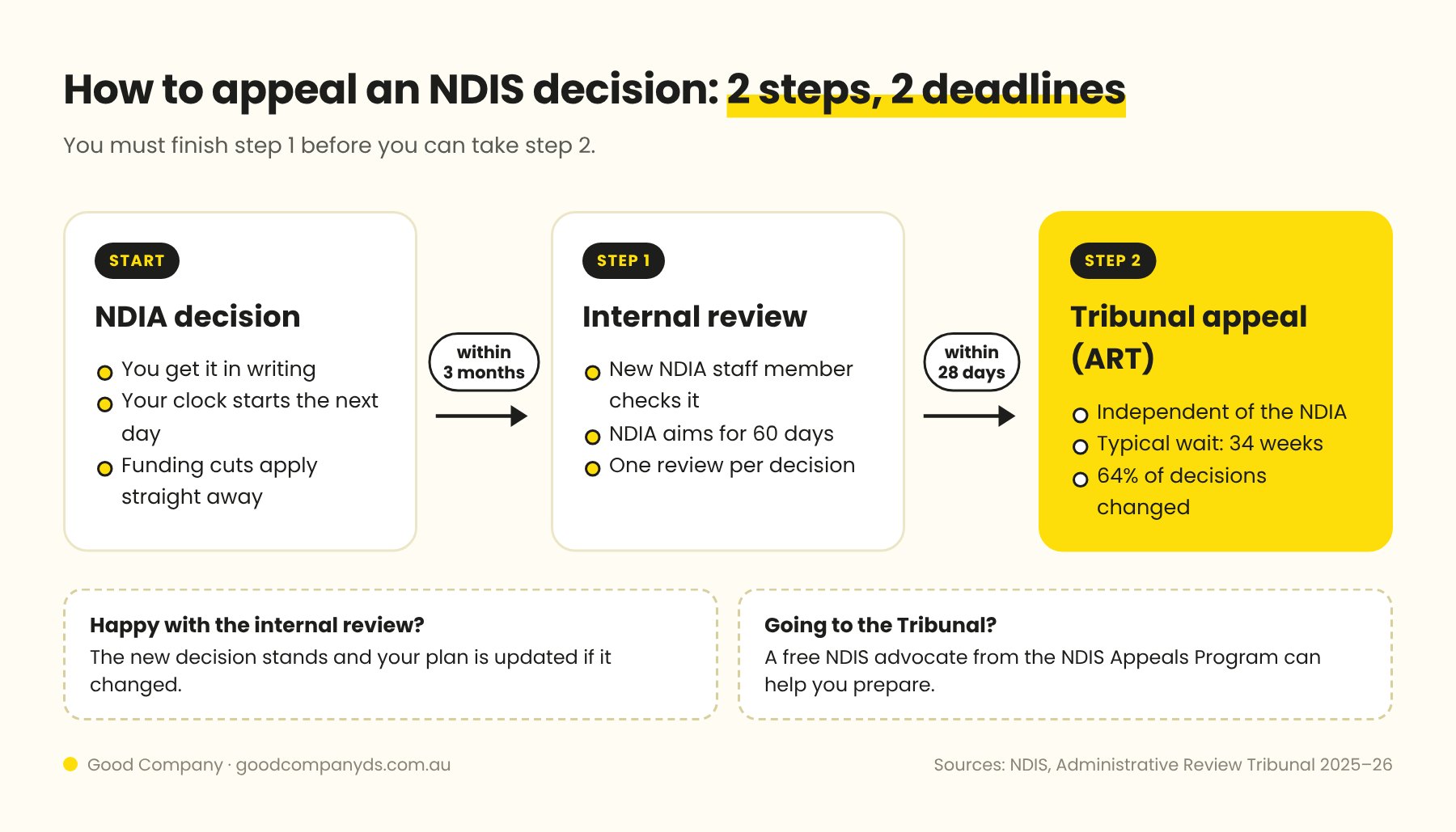
- Get the decision in writing. Note the date you received it, because your time limits count from the next day. If you aren’t sure why the decision was made, you can call the NDIS on 1800 800 110 and ask them to explain it.
- Check the decision can be reviewed. Most eligibility and plan decisions can be, including approving your plan, refusing a plan reassessment or variation, and changing your plan. Some can’t: the NDIA says, for example, that budget reductions on their own aren’t a reviewable decision. If you’re unsure, ask.
- Ask for an internal review within 3 months. Someone at the NDIA who wasn’t involved in the original decision looks at it again, along with any new evidence you give. You only get one internal review of the same decision, so make it count.
- Wait for the internal review decision. The NDIA aims to finish internal reviews within 60 days. If it asks you for more information, you usually have 28 days to send it.
- Still disagree? Apply to the Tribunal within 28 days of getting the internal review decision. The Administrative Review Tribunal is independent of the NDIA.
- Case conference, then a hearing if needed. Many NDIS cases settle through conferences and agreement before they reach a formal hearing. As the queue grows, every stage takes longer.
How to request an NDIS internal review
According to the NDIS, you can ask for an internal review by:
- sending the NDIS “Request for a review of a decision” form (PDF or Word, from the NDIS website)
- calling 1800 800 110
- sending an enquiry with your evidence through the NDIS service hub
- writing to the Chief Executive Officer, NDIA, GPO Box 700 Canberra ACT 2601
- visiting a local NDIS office.
Whichever way you ask, tell the NDIA what decision you expected, why you think it should be different, and whether you’ll send new evidence. A family member, friend, local area coordinator or nominee can ask on your behalf if you give your permission.
AAT or ART? The Tribunal’s new name
If you’ve heard of NDIS appeals going to the “AAT” (Administrative Appeals Tribunal), that body was replaced by the Administrative Review Tribunal (ART) in October 2024. Older guides, letters and online forums may still say AAT, but NDIS external reviews now go to the ART.
NDIS Tribunal appeals by the numbers (2025–26)
The Tribunal is finishing more NDIS cases than ever, but new cases are arriving even faster. The ART’s 2025–26 annual report, released in late October 2026, gives the clearest picture yet.
| Measure | 2024–25 | 2025–26 | What it means |
|---|---|---|---|
| NDIS review applications lodged | 7,935 | 9,351 | Up 18% in a year, and about 130% on 2023–24 |
| NDIS cases finalised | — | 8,082 | Up 61%: the Tribunal is working faster |
| Cases still open at 30 June | — | 7,077 | Up about one-fifth: the queue still grew |
| Median time to finalise | 27 weeks | 34 weeks | Half of all cases take more than 8 months |
| Finalised within 12 months | — | 77% | Nearly 1 in 4 takes over a year |
| Decision changed on review | 73% | 64% | Most decisions taken to the Tribunal change |
| Share of appeals about plans | — | 80.1% | Most disputes are about funding, not eligibility |
NDIS matters are now the Tribunal’s third-largest workload, behind migration and protection visas. One note on the headline: the “130%” compares 2025–26 with 2023–24, two years apart. The rise in the most recent single year was 18%.
The Tribunal has been frank about the strain. In its previous annual report, its principal registrar said it didn’t have the staff, members or technology to manage the caseload it already had, and warned that waits grow as the backlog grows (ABC News).
Why more people are appealing NDIS decisions
Appeals are rising because more decisions are reducing or refusing supports at a time when the scheme itself is being reshaped. Several things are happening at once:
- Plan decisions are tighter. Eight in ten appeals are about what a plan funds. When a plan comes back with fewer hours or a support removed, the review pathway is the only formal way to challenge it.
- The scheme is being resized. The Federal Government wants to slow NDIS growth. The NDIS Minister has spoken of around 600,000 participants by the end of the decade rather than the forecast 900,000, with more people supported through “foundational supports” outside the NDIS (ABC News). We explain what that could mean for your plan in What the NDIS Savings Plan Means for Your Plan in 2027.
- New laws took effect in August 2026, changing how and when plans can be changed (more below).
- Planning is changing again. “New framework planning”, with a support needs assessment and a flexible budget, is being phased in. The NDIA has said review rights stay in place under it (NDIS).
Disability lawyers and advocates have warned that more removals from the scheme and more contested plans could push the Tribunal’s queue out further. The government says the changes are needed to keep the scheme sustainable and that the NDIS will still grow each year. Either way, participants and families are likely to need the review process more, not less.
Is an NDIS appeal worth it? Most decisions change
Most NDIS decisions taken to the Tribunal end up changed. The Tribunal’s own figures show 64% of NDIS cases in 2025–26 resulted in a changed outcome, down from 73% in 2024–25 (ABC News).
The NDIA counts differently. It measures whether the final result lined up with the agency’s own position, and on that basis says most cases were resolved in its favour. The Tribunal counts whether the original decision was affirmed, varied or set aside. Both can be true at once: a decision can be changed by agreement in a way the NDIA was willing to accept.
What matters for you is that a decision you think is wrong isn’t necessarily final. People have had access or funding restored through this process. The ABC reported the story of a Gold Coast grandmother who was refused the NDIS four times, then accepted at Tribunal mediation with an advocate’s help.
One important catch: when funding is cut or removed, the change takes effect straight away, even while you appeal. That’s why planning for the waiting period matters so much (see the tips below).
How the August 2026 law changes affect NDIS reviews
Your right to an internal review and a Tribunal appeal hasn’t changed. What has changed is how you ask for a new plan. The NDIS Amendment (Securing the NDIS for Future Generations) Act 2026 received Royal Assent on 20 August 2026, and its plan changes started on 27 August 2026 (Centre of Hope summary). For reviews, three things matter most:
- A new plan now needs a “significant and ongoing” change in your circumstances, asked for on the official form with evidence.
- The NDIA now has 90 days (up from 21) to decide whether to reassess your plan. If it doesn’t decide in time, that counts as a refusal, which is then reviewed automatically.
- A refusal to reassess or vary your plan is itself a reviewable decision, so the same 3-month internal review clock applies.
For the full picture of what changed this year, see our guide to NDIS changes in 2026.
Challenging a decision, or asking for a new plan? Know which one you need.
An internal review is how you challenge a decision you think is wrong. Asking for a new plan because your needs have changed is a different process: a plan reassessment. Many people use the word “review” for both, but ask for the wrong one and the 3-month internal review clock keeps ticking. If your needs have changed, read 6 signs it may be time for a plan reassessment.
New framework planning is coming next. The NDIA is moving to a support needs assessment and a mix of stated supports and a flexible budget, introduced in phases. It has indicated this will start from April 2027, with children under 18 not in the first group, and it has confirmed that internal reviews and Tribunal appeals remain available under the new approach (NDIS; Department of Health).
8 ways to protect yourself while your NDIS review is waiting
With appeals taking months, preparation is the best protection you have. These steps work whether you’re at internal review or already at the Tribunal.
- Put the deadlines in your calendar today: 3 months from the day after you receive the decision for an internal review, and 28 days from the internal review result for the Tribunal.
- Keep every letter and note every call. Write down the date, who you spoke to and what they said. A simple folder or phone note is enough.
- Explain exactly what you disagree with. Say what decision you expected and why. For example: “I need 10 hours of community support a week to keep my job, and the plan funds 4.”
- Get evidence that links your disability to the support. Ask your GP, therapist or specialist to describe what has changed, how it affects daily life, and which supports they recommend and why. A diagnosis alone is rarely enough.
- Use what your support team already sees. Session notes and provider progress reports can show how supports are working and what happens without them. Ask your providers for reports early, because they take time to write.
- Flag urgent situations clearly. A risk to your health or safety, losing your informal supports, or waiting in hospital to be discharged can justify faster handling. Say so when you ask for the review.
- Ask about a plan variation for short-term gaps. Some small or urgent changes can be made without waiting for the full review.
- Don’t go it alone. A free NDIS advocate can help you prepare, attend conferences with you, and connect you with free legal help (see below).
Free NDIS advocacy and appeal help in WA and Victoria
Free, independent NDIS advocacy is available in every state through the government-funded NDIS Appeals Program. Once your internal review is finished, an NDIS advocate can help you understand the process, prepare documents, and attend Tribunal conferences and hearings with you. Legal help is available through Legal Aid in each state. In 2024–25 the program supported 4,469 people nationally.
Western Australia (from the Department of Health’s provider list):
| Organisation | Phone |
|---|---|
| Advocacy WA | 08 9721 6444 |
| People With Disabilities WA | 08 9420 7279 |
| Kin Advocacy | 1800 659 921 |
| Midland Information, Debt and Legal Advocacy Service (MIDLAS) | 08 9250 2123 |
| Sussex Street Community Law Service | 08 6253 9500 |
| Legal Aid WA | 1300 650 579 |
Victoria: several funded advocacy organisations offer NDIS appeals support, and Victoria Legal Aid explains your review rights. For psychosocial disability, VMIAC runs an NDIS Appeals Advocacy Service.
Anywhere in Australia: search by postcode in the Ask Izzy Disability Advocacy Finder.
You can’t use your NDIS funding to pay someone to represent you at the Tribunal, which is why these free services matter.
How Good Company can help while you wait
We’re not lawyers or advocates, but we can make the waiting period easier and your evidence stronger. Good Company supports NDIS participants across Perth and Melbourne through one-to-one NDIS mentoring, with remote support in other areas.
- Evidence from real life. Our mentors write a case note for every session. With your consent, we can prepare a provider report that shows what your supports achieve: the kind of everyday evidence a reviewer can’t see from a form.
- Getting organised. We can help you sort letters, track your deadlines and work out what to ask your treating team for.
- Connecting you with the right help. If you need an advocate or legal advice, we’ll point you to free services like the ones above.
- Keeping life moving. Mentoring for work, study, community participation and confidence keeps going while you wait. That’s what we’re here for.
Waiting on an NDIS review? Talk to us. Call or text 0480 804 282, email hello@goodcompanyds.com.au, or send us a message. We reply within one business day.
NDIS internal review and appeal FAQs
How long do I have to ask for an NDIS internal review?
Three months, counted from the day after you receive the decision in writing. After that the NDIA can’t do an internal review, but you may be able to ask for a plan reassessment or variation instead.
What is the NDIS internal review time frame?
The NDIA aims to finish internal reviews within 60 days. If it asks you for extra information, you usually have 28 days to provide it. Flag urgent situations when you ask.
What form do I use to request an NDIS review?
The NDIS “Request for a review of a decision” form, available as a PDF or Word document on the NDIS website. You don’t have to use the form: you can also ask by phone, through the service hub, by letter or in person.
Can I go straight to the Tribunal?
No. You must finish an NDIA internal review first, then apply to the Administrative Review Tribunal within 28 days of the result. This second step is called an external review.
How long does an NDIS Tribunal appeal take?
In 2025–26 the median was 34 weeks from lodgement to finish, and 77% of cases were finalised within 12 months.
Does my funding continue while I appeal?
No. A cut or removal takes effect straight away, even if you appeal. Ask about a plan variation for urgent short-term needs.
Is the AAT still handling NDIS appeals?
No. The Administrative Appeals Tribunal (AAT) was replaced by the Administrative Review Tribunal (ART) in October 2024. NDIS appeals now go to the ART.
Do I have to pay for an NDIS advocate?
No. NDIS Appeals Program advocates are free and independent of the NDIA.
This article is general information, not legal advice. Rules and timeframes can change, so check ndis.gov.au or call the NDIS on 1800 800 110 before acting.
Sources
- Administrative Review Tribunal: Caseload report, 1 July 2025 to 30 June 2026
- Administrative Review Tribunal: Annual Report 2025–26
- CathNews (from The Australian): NDIS dispute cases surge by 130 per cent, 26 Oct 2026
- ABC News: Fears NDIS tribunal delays will worsen, 2 Aug 2026
- NDIS: How to request a review of a decision
- NDIS Our Guidelines: How can you ask for an internal review?
- NDIS: Update: a new way of planning
- Department of Health: NDIS new framework planning resources
- Department of Health: NDIS Appeals Program
- Centre of Hope: NDIS plan reassessment 2026
- Victoria Legal Aid: Your review rights and the NDIS