
If you or someone you support has an intellectual disability, the NDIS can fund a lot of practical help: building everyday skills, joining in community life, finding work and, for some people, support to live away from the family home. Getting in, and getting the right plan, comes down to evidence.
This NDIS intellectual disability guide explains how the scheme treats intellectual disability, what evidence the NDIA looks for, how mild and moderate intellectual disability are handled differently, which supports people most often use, and what the 2026 law changes mean. It’s part of our intellectual disability hub.
In short
- The NDIS funds supports for intellectual disability when it is permanent and substantially affects everyday life.
- Moderate, severe and profound intellectual disability are on the NDIS’s List A, which usually makes access simpler.
- Mild intellectual disability can still qualify, but you need strong evidence of how it affects daily life.
- Good evidence describes what the person can and can’t do, not just an IQ score.
- New access rules under the 2026 law are planned to start for new applicants from 2028.
Is intellectual disability covered by the NDIS?
Yes. Intellectual disability is one of the largest disability groups in the NDIS. To get access, you need to meet the disability requirements, which in plain English means:
For intellectual disability, NDIS access follows the same rules as for other people with disabilities. What changes is the evidence: the NDIA looks closely at the level of intellectual disability and how it affects everyday life.
- you have an impairment that is permanent (likely to be lifelong)
- it substantially reduces your ability to do everyday activities
- it affects your ability to work, study or take part in community life
- you’re likely to need NDIS support for your lifetime.
You also need to be under 65 when you apply, live in Australia, and be an Australian citizen, permanent resident or hold a Protected Special Category Visa. Our general guide to who is eligible for the NDIS covers these rules for every disability type.
What List A means for intellectual disability
The NDIA keeps lists of conditions that make access decisions simpler. List A covers conditions the NDIA accepts as permanent and substantially affecting daily life once the diagnosis is confirmed. It includes intellectual disability assessed as moderate, severe or profound using current diagnostic criteria.
If you’re on List A, you usually only need to prove the diagnosis and its severity, not argue every point of the disability requirements. You’ll still need a report from a qualified professional, usually a psychologist or paediatrician, that states the diagnosis and level.
Mild intellectual disability isn’t on List A
That doesn’t mean you can’t get in. It means the NDIA will look closely at functional impact: how much the disability affects communication, social interaction, learning, self-care, self-management and mobility. Plenty of adults with mild intellectual disability are NDIS participants because their evidence showed this clearly.
What evidence does the NDIA look for?
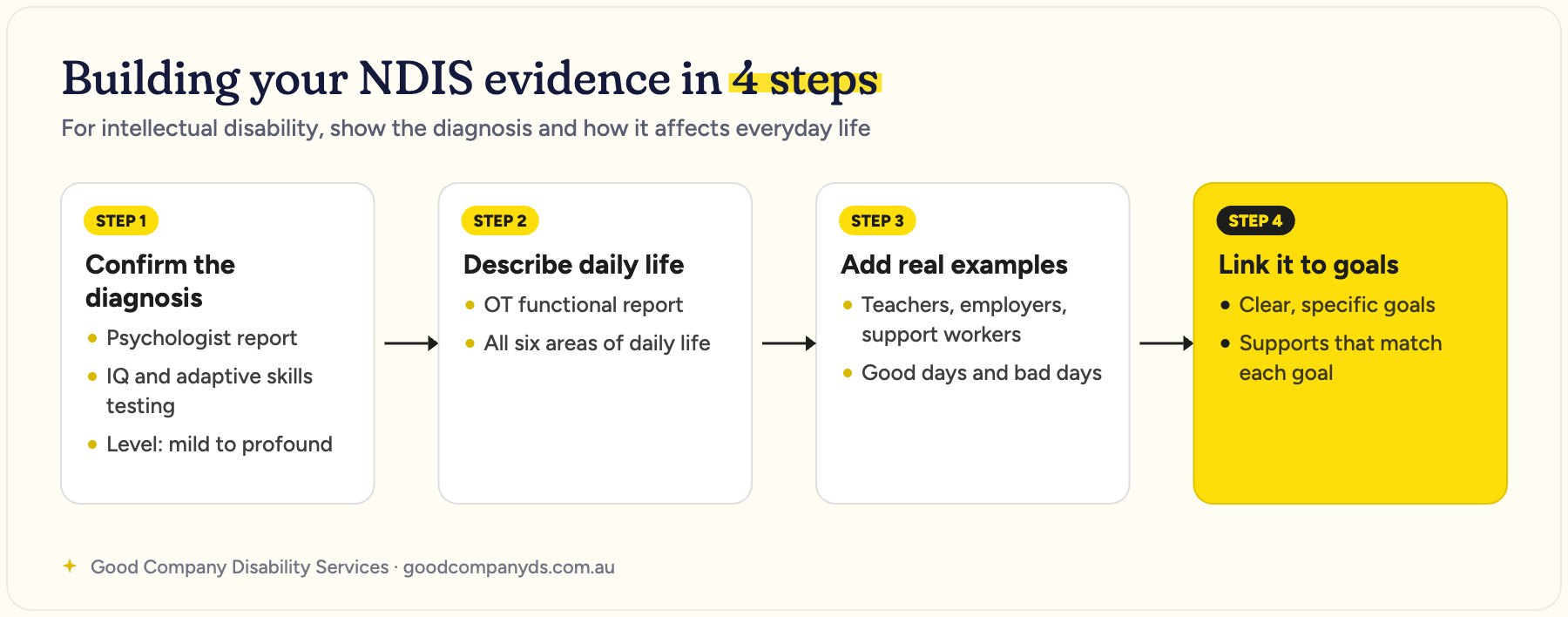
The NDIA wants to understand two things: whether the disability is permanent, and how much it affects daily life. For intellectual disability, strong evidence usually includes:
- A diagnostic assessment from a psychologist, with cognitive testing (an IQ score) and an adaptive functioning assessment such as the ABAS or Vineland.
- A functional report, often from an occupational therapist, describing what the person needs help with day to day.
- Everyday evidence from teachers, employers, support workers or family that shows real examples.
- History: school reports, early childhood assessments or previous reports that show the disability started in childhood.
Describing the six areas of daily life
The NDIA looks at six functional areas. For each, describe what happens on a normal day and what support is needed:
| Area | What to describe | Example |
|---|---|---|
| Communication | Understanding and being understood | Needs instructions broken into short steps |
| Social interaction | Making and keeping relationships | Finds new groups overwhelming without support |
| Learning | Picking up new skills and information | Needs a task practised many times in the real setting |
| Self-care | Hygiene, eating, health | Needs reminders to take medication on time |
| Self-management | Money, decisions, planning, safety | Can’t budget for the week or spot a scam |
| Mobility | Moving around home and community | Can walk, but can’t plan an unfamiliar bus trip |
Be honest about bad days as well as good ones. Families often describe the best version of a person’s week, which can understate the support they really need.
Mild vs moderate intellectual disability: how access differs
| Mild | Moderate, severe or profound | |
|---|---|---|
| On List A? | No | Yes |
| Main evidence | Functional impact across daily life | Diagnosis and severity |
| Key reports | Psychologist plus OT or support worker reports | Psychologist or paediatrician report |
| Common risk | Being refused because reports focus on IQ, not daily life | Delays from missing or outdated reports |
If your application is refused, you can ask for an internal review within three months. Our NDIS internal review and appeals guide explains how.
Which NDIS supports do people with intellectual disability use?
Supports depend on your goals, but these come up most often:
- Capacity Building, Daily Activity: building skills like cooking, money, travel and routines.
- Capacity Building, Social and Community Participation: joining clubs, classes and groups with support to build confidence.
- Capacity Building, Employment: support to find and keep a job, including SLES for school leavers.
- Core, Assistance with Daily Life and Social and Community Participation: hands-on support in daily life and the community.
- Support coordination: help to understand and use your plan.
- Home and living: supports that make living away from home possible, such as Supported Independent Living or Individualised Living Options.
Writing specific goals helps. “I want to catch the bus to TAFE on my own by July” gives the NDIA a clear reason to fund travel training and mentoring. See our NDIS goals examples for more.
What the 2026 NDIS law changes mean
The NDIS Amendment (Securing the NDIS for Future Generations) Act 2026 received Royal Assent in August 2026. The parts that matter most for people with intellectual disability:
- Plan changes have already started, including new rules for reassessments.
- From 1 October 2026, some funding for social and community participation and daily living skills has been reduced for plans that start after that date. Read what’s still funded.
- From 2028, access for new applicants is planned to move to a standardised functional capacity assessment rather than diagnosis lists. Existing participants are expected to be reassessed gradually after that.
- New framework planning, with a new support needs assessment, is scheduled to start from April 2027.
Dates and details can still change, so check ndis.gov.au or call the NDIS on 1800 800 110 before acting. Our NDIS changes 2026 article tracks the timeline.
How Good Company helps
Most of the adults we mentor live with intellectual disability. Our mentors work one-on-one with you in real places, like the bus stop, the shops, work or the gym, and write progress notes that become useful evidence at plan reassessments. We support people across Perth and Melbourne, with remote support elsewhere.
Questions about NDIS support for intellectual disability? Call or text 0480 804 282, email hello@goodcompanyds.com.au, or send us a message. We reply within one business day.
NDIS and intellectual disability FAQs
Is mild intellectual disability covered by the NDIS?
It can be. Mild intellectual disability isn’t on List A, so you need evidence that it permanently and substantially affects your daily life, such as reports from a psychologist and occupational therapist plus real examples from people who support you.
What IQ do you need for the NDIS?
There’s no IQ cut-off on its own. List A refers to moderate, severe or profound intellectual disability, which usually means an IQ around 55 or below with significant difficulties in everyday skills. People with higher scores can still qualify if their functional evidence is strong.
Who can diagnose intellectual disability for the NDIS?
Usually a psychologist, sometimes with a paediatrician or psychiatrist. The report should include cognitive testing, an adaptive functioning assessment and the level of intellectual disability.
Do I need a new assessment as an adult?
Not always. If your childhood assessment clearly shows a lifelong intellectual disability and its level, the NDIA may accept it. Newer reports help when the old ones are vague, out of date or don’t describe daily life now.
Will the 2026 changes affect my existing NDIS plan?
Some plan changes have already started. New access assessments are planned for new applicants from 2028, with existing participants reassessed gradually after that. Check ndis.gov.au for the latest.
This guide is general information, not advice about your situation. NDIS rules change, so check ndis.gov.au or call the NDIS on 1800 800 110 before acting.